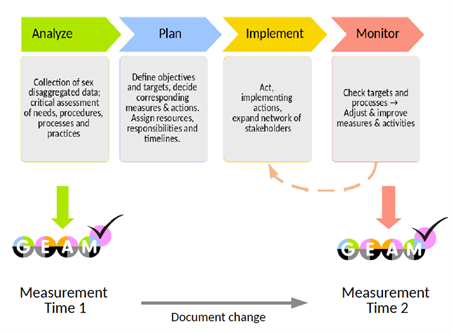
In a world striving for gender equality, it is vital to have tools that help organisations navigate the path toward balance and fairness. The Gender Equality Audit and Monitoring (GEAM) tool can provide the necessary insights to identify disparities, track progress, and implement effective policies.
Exploring the GEAM Tool
The GEAM tool, developed as a component of the ACT project, is an integrated environment for conducting survey-based gender equality audits within research and innovation organisations or organisational units.
GEAM delves into the experiences and perceptions of employees on critical aspects of gender equality. It covers various dimensions, such as working conditions, perceived discrimination, experiences of sexual harassment, and micro-aggressions, among others.
It provides an in-depth account of intersecting inequalities within an organization, independent of the existence and content of GEPs. Therefore, the GEAM tool lets each organisation take control of its own gender equality efforts. This unique feature has been instrumental in its success, particularly in fostering gender audits in widening/associated countries. So far, it has been utilised by 21 Research Performing Organisations (RPOs), primarily in Eastern Europe, with approximately 2600 responses.
GEAM Version 3
The INSPIRE project is currently hard at work, developing GEAM version 3. This iteration has a dual focus: enhancing its inclusivity in both the private sector and the student population within Higher Education institutions. The development process involves online participatory methods to brainstorm and refine key dimensions for the new questionnaire items. The resulting feedback will be instrumental in shaping the new questionnaire items, which will then be piloted across various organisations.
Anticipated for release in 2024, GEAMv3 will see its new items integrated into the GEAM service platform, expanding on the existing standardised questionnaire. It will be made available through support packages to organisations looking to conduct gender equality audits.
While each organisation owns the data they generate with the tool, there is significant potential to develop multilevel (hierarchical) models of the data, across countries and types of organizations. By combining datasets, we can also delve deeper into intersectional analyses. This approach is especially valuable when examining categories with low response rates within individual organisations.
The GEAM tool aims to create data that serves as the compass guiding our journey towards gender equality. With data, we empower evidence-based decision-making, fostering a more inclusive and equitable future for all.
Discover the GEAM
To explore the GEAM tool further, visit the official website: https://geam.act-on-gender.eu
References
Aldercotte, Amanda, Maria Caprile, Kevin Guyan, Memory Malibha-Pinchbeck, Jörg Müller, Rachel Palmén, and Carla Startin. 2019. “ACT - Gender Equality Audit and Monitoring (GEAM).” Zenodo, September 10.5281/zenodo.3476725.
By: Dalia Argudo Barrera, Notus Social Research