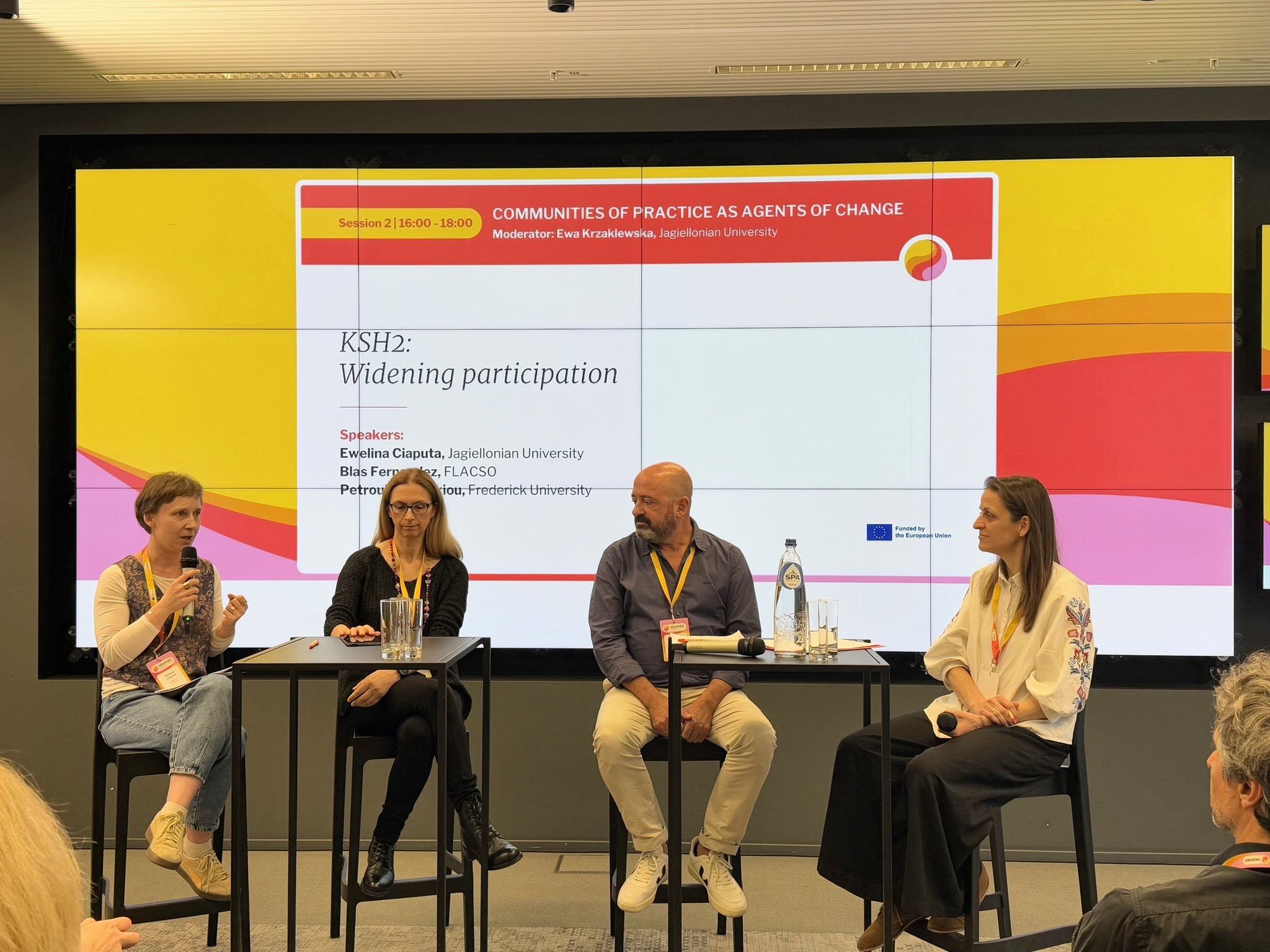
The INSPIRE project conference in Brussels served as a closing event summarizing the work carried out within the project and highlighting new challenges faced by European policymakers in the field of gender equality in research and innovation. It brought together nearly 150 participants, including representatives of the WIGE Community.
On the first day of the conference, a panel discussion moderated by Dr Ewa Krzaklewska focused on activities implemented within the Communities of Practice from the Central and Eastern Europe region (WIGE) and Latin America (Latin America CoP). The discussion featured representatives of diverse institutions: Ewelina Ciaputa, a researcher in the project and coordinator of the Gender Equality Plan at Jagiellonian University in Kraków since 2023, facilitator of the WIGE community and its active member; Blas Fernandez from FLACSO Argentina, coordinator of the South American Community of Practice; and Professor Petroula M. Mavrikiou, Director of the Centre for Gender Equality and Inclusion at Frederick University in Cyprus, involved in the WIGE community.
The experiences highlighted both similarities and differences in the challenges faced by institutions, depending on cultural, social, and political contexts. Blas Fernandez (FLACSO Argentina) spoke about “pendulum politics” in Latin American countries, where the political landscape shifts dramatically between electoral cycles, making it difficult to establish and sustain long-term institutional change. Resistance to gender equality policies is also present in Central and Eastern Europe, where anti-gender discourse and mobilizations constitute a barrier to implementing such policies at both national and institutional levels. As part of regional cooperation and collaboration with Latin America, discussions also addressed the implementation of gender equality and intersectional policies, as well as their local conditions (one report from these discussions is available here: Intersectionality from Regional Perspectives).


