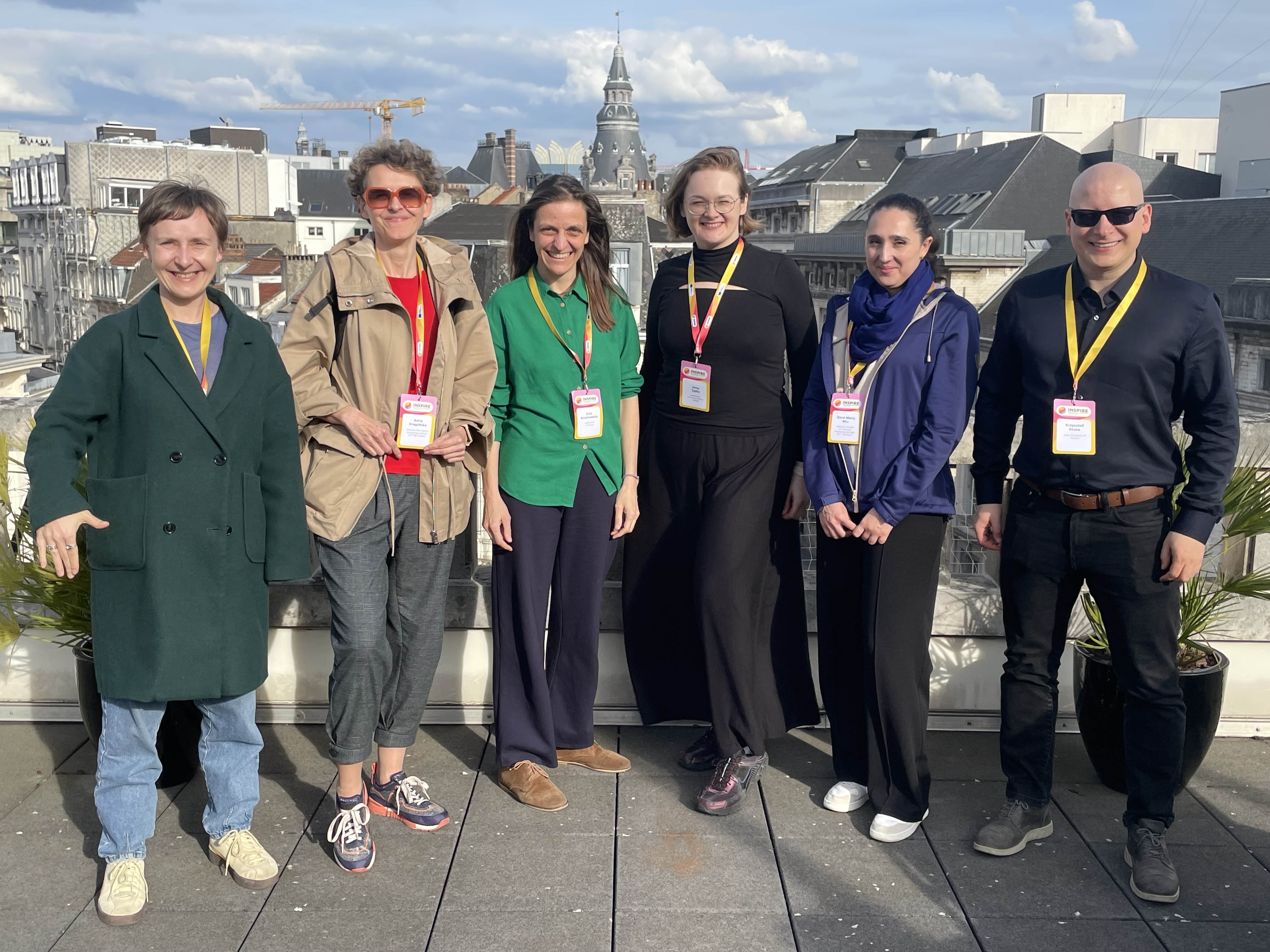
At INSPIRE’s final conference in Brussels in April 2026, one question stayed with me long after the discussions had ended: What actually makes change stick?
As we reflected on years of collaboration across INSPIRE’s Communities of Practice, one insight came through strongly: lasting change does not happen only through policies, frameworks or project outputs. It happens through people working together. Across institutions. Across countries. Across differences. Sharing not only knowledge, but also doubts, strategies and courage.
And perhaps this is what our Communities of Practice have taught us most clearly: change is not linear. We often speak about institutional change as if it follows a predictable path. A strategy is developed. Actions are implemented. Progress follows. But our discussions in Brussels reminded me how rarely change works this way.
Whether we talked about sustaining change, widening participation, embedding intersectionality or fostering innovation, a common thread emerged: change involves resistance, uncertainty and negotiation. It moves forward unevenly - sometimes slowly, sometimes quietly. But through persistence, it takes root. For me, this is not a sign of weakness in equality work. It is part of the reality of transformation.
And perhaps recognising this reality helps us approach change work with greater honesty, resilience and ambition.
Communities of Practice as agents of change
This is where Communities of Practice matter. At the conference, I spoke about how change does not happen only through research, policies or frameworks - it happens through people working together.
I believe this even more strongly now. Because what INSPIRE has shown is that Communities of Practice are not simply spaces for exchange. They are spaces where trust is built, assumptions are challenged, experimentation becomes possible and difficult work is carried together. They help move us from intention to implementation; from individual effort to collective progress; and from short-term actions to more lasting change. And in times when equality work can meet resistance or fatigue, this matters profoundly. Because communities help sustain momentum. They help make change stick.
Solidarity as practice
Another reflection I took from Brussels is that solidarity is often spoken about as a principle. But in INSPIRE, I have seen solidarity as practice.
Solidarity is built when we learn across differences; when we share strategies as well as struggles; when we support rather than isolate those doing difficult institutional work; and when communities make room not only for innovation and critique, but also for care. This matters because lasting change is not sustained by structures alone. It is sustained by relationships.
And perhaps this is one of the quieter but most important lessons from Communities of Practice: collaboration, trust and care are not “soft” dimensions of change. They are part of its infrastructure.
From projects to continuity
Another important theme at the conference was continuity. The end of a project cannot mean the end of the community. If anything, this is where the real test begins.
How do we carry forward what has been built? How do we sustain these practices beyond project funding? How do we continue learning from and supporting each other?
These questions feel central to INSPIRE’s legacy. Because perhaps the strongest legacy of our Communities of Practice is not only what they have produced during the project, but what they make possible beyond it.
What makes change stick?
If I take one lesson with me from INSPIRE, it is this: lasting change is rarely driven by isolated champions or linear progress. It is carried by communities - through shared persistence and relationships strong enough to hold the work through challenge as well as possibility.
And perhaps that is what makes change stick: not smooth or uninterrupted progress, but our willingness to stay connected, keep learning and carry the work forward together.
By: Liv Baisner Petersen, University of Southern Denmark